Blocked Stormwater Drains Gold Coast
Yard flooding, surcharging pits and overflowing downpipes on the Gold Coast are a stormwater problem — a separate pipe system from the drain that carries waste water. Clearing the sewer drain will not touch it. One call puts it in front of a drainage contractor.
If it only happens in the rain, this is the page and the call.
- Open 24 hours, seven days a week
- Pooling, surcharging pits and downpipe overflow during rain
- Blocked drains only — no forms, no callback queue
Two systems, one common mix-up
Most properties have two independent underground drainage systems. One carries waste water from your fixtures. The other carries rain off roofs and paved areas. They run separately, they are blocked by different things, and they are cleared through different access points.
This trips people up constantly, and it costs money when it does. Calling about a "blocked drain" when the yard floods in a downpour, and having someone clear the sewer line, achieves precisely nothing — the sewer line was never the problem. Being able to say "this only happens when it rains, and there is no waste water involved" puts the right person on the right pipe.
What happens when you call about stormwater
Stormwater calls are easier to place than sewer calls, because the timing tells most of the story.
-
You describe what the drain is doing
Whether it only happens in rain, how heavy the rain has to be, where the water appears, and whether any waste water is involved — that last one decides which system you are describing.
-
The job goes to a drainage contractor
Your call is matched to an independent licensed drainage contractor working across the 6 Gold Coast suburbs covered here. Phone is the only way in — there is no form, no callback queue and no chat widget.
-
They arrange attendance, quote and invoice you directly
Scope, timing and cost are agreed between you and the contractor who does the work. Their licence, their insurance and their workmanship are theirs.
Water pooling every time it rains?
The line is open open 24 hours, 7 days. Have the short version of the problem ready and the call is quicker for both of you.
Call 0483 909 757Stormwater versus the sanitary drain
Side by side, so you can place your own situation in one column or the other.
| Stormwater system | Sanitary sewer drain | |
|---|---|---|
| What it carries | Rain from roofs, gutters, paving and yards | Waste water from toilets, sinks, showers and laundries |
| When problems appear | During and just after rain | Any time water is used, rain or not |
| What surfaces | Rainwater — dirty, but not sewage | Waste water, which is a health risk |
| Typical blockage material | Leaves, silt, sand, roots, damaged pipe | Grease, wipes, paper, roots, damaged pipe |
| Typical entry points | Grates, pits, downpipe connections, inspection points | Drain inspection openings, overflow gully, chambers |
| What clearing the other one achieves | Nothing — they are separate pipes | Nothing — they are separate pipes |
If your situation lands in the right-hand column, blocked sewer drains is the page you want.
What a stormwater problem looks like
Note when each of these happens and how long it takes to clear — both are useful before anyone attends.
-
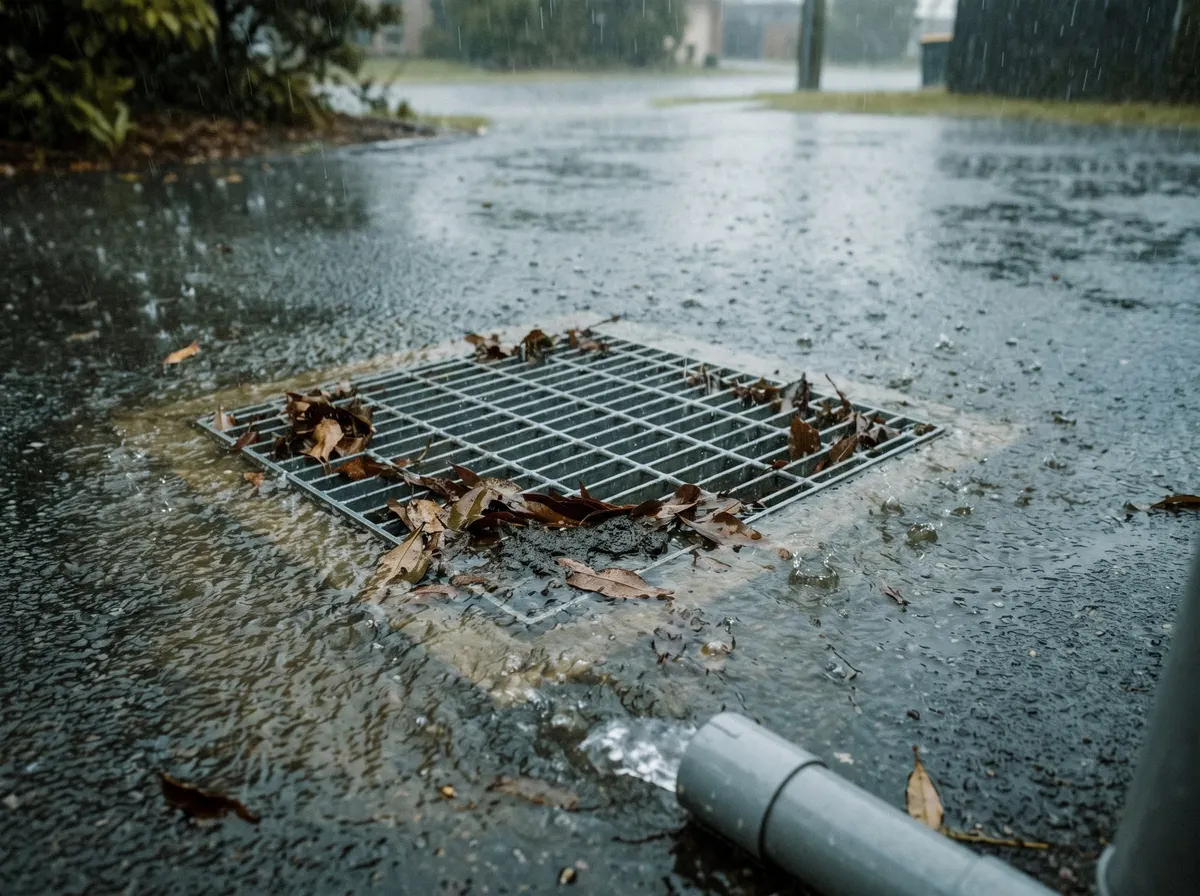
A pit or grate fills and surcharges during heavy rain, then drains away afterwards
Classic partial blockage. The line still flows, just not fast enough to keep up with the volume arriving. It will get worse as the restriction builds.
-
Water pools in the same low spot in the yard after every downpour
Either the water is not reaching an inlet, or the line taking it away is restricted. Where the water sits is a strong clue about which.
-
A downpipe overflows at the top or spills at the base
Something below the downpipe is not accepting the flow. Often the connection point or the first section of underground line.
-
Gutters overflow even though they were recently cleaned
If the gutter is clear and it still overflows, attention moves down the system rather than staying in it.
-
Water comes back up out of a grate rather than going down
The line downstream is full or blocked. Worth noting how far the water rises and how long it takes to clear.
-
Damp or seepage against a wall or slab edge after rain
Water that cannot leave through the drainage system will find somewhere else to go. Worth acting on rather than living with.
Yard flooding every time it rains?
Useful to mention: where the water sits, whether a grate or pit is involved, and whether it drains away on its own afterwards.
Call 0483 909 757Worth checking before you call
None of these require going near anything underground, and any one of them can save a visit.
-
The visible inlets
Grates, pits and channel drains collect leaves and silt at the surface. If an inlet is covered, water was never getting into the system to begin with.
-
The gutters and downpipes
An overflowing gutter can be a gutter problem rather than a drain problem. Ruling that out first is quick, and it changes what needs to happen next.
-
What changed
New paving, landscaping, a new structure or recent building work upstream can alter where water goes or leave debris in the line. Recent change is a genuinely useful clue.
If the surface is clear and the problem persists, the restriction is underground. A drain that surcharges in the same place every time is a candidate for inspecting recurring stormwater blockages, because roots and damaged pipe look identical from above and need different answers.
Questions about blocked stormwater drains
How do I know it is stormwater and not the sewer?
Two questions settle it most of the time. Does the problem only appear when it rains? And is there any waste water involved — anything coming from a toilet, sink, shower or laundry? A rain-only problem with no waste water is a stormwater problem. Waste water backing up indoors, rain or no rain, is the sanitary drain.
What usually blocks a stormwater drain?
Leaf litter and silt are the everyday causes — fine material settles in flatter sections while leaves accumulate at inlets, pits and bends. Roots and damaged or displaced pipe cause the more stubborn cases, because they keep catching material after each clear. Sand and building debris show up on properties where there has been recent work.
Can I clear it myself?
Clearing debris from surface grates, pits you can safely reach, and gutters is ordinary property maintenance and is often all that is needed. What is worth being careful about is anything underground and out of sight — that is where you can compact a partial blockage into a complete one, or damage a pipe that was already fragile.
Why does it only happen in really heavy rain?
A partially blocked line still works. It just has less capacity than it was designed for, so it copes with ordinary rain and fails when volume spikes. That is why a problem that "only happens sometimes" is worth investigating rather than waiting out — the restriction is there the whole time.
Get the stormwater line looked at
Best time to call is after you have seen it happen, while you can still describe where the water went.
Call 0483 909 757