High Pressure Drain Jetting Gold Coast
For Gold Coast drains that keep blocking in the same place, jetting is the method that scours the pipe wall rather than punching an opening through the blockage. Independent licensed drainage contractors do the work; one call gets your drain described to one of them.
Mention how often this drain has blocked before.
- Open 24 hours, seven days a week
- Grease, silt and root matter that clearing alone keeps leaving behind
- Blocked drains only — no forms, no callback queue
What jetting actually does
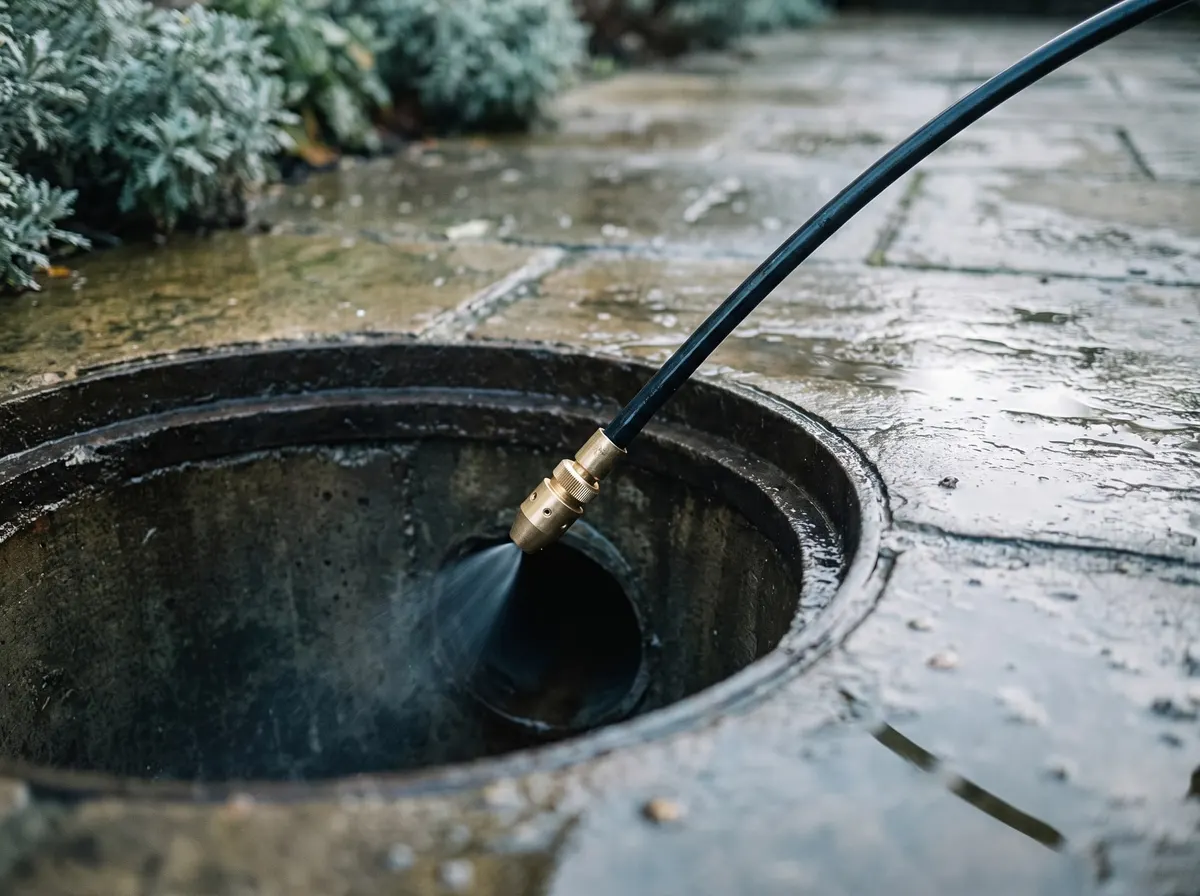
A jetting nozzle is fed into the drain on a hose. Most of the jets face backwards. That does two things at once: the reaction drives the nozzle forward along the pipe, and the water sweeps loosened material back toward the point where the hose went in. A smaller forward jet does the cutting.
The reason this matters is that blockages are usually the end of a slow process, not a single event. Fat cools and sets on the pipe wall. Silt settles in the flatter sections. Fibrous material catches on a rough joint. By the time the drain finally stops, the pipe has often been getting narrower for a long time. Opening a channel through that gets water moving again; taking the deposit off the wall is what buys you a longer gap before the next one.
Where jetting is and is not the right tool
| What is in the pipe | Typical suitability | Why |
|---|---|---|
| Grease and fat build-up | Often well suited | Water shears the deposit off the wall instead of boring a channel through it. |
| Silt, sand and sludge | Often well suited | Loose material flushes back toward the access point rather than compacting. |
| Fine root hair and soft root mass | Sometimes suited | Jetting can cut and flush root matter, but roots re-enter through the same defect unless that defect is dealt with. |
| Solid foreign objects | Frequently not suited | Water pressure does not grip a solid object. Retrieval or a different tool is usually needed. |
| Collapsed or badly displaced pipe | Not suited | There is nothing to clear. The pipe itself has failed and needs repair, which is a separate decision. |
| Pipe already in poor condition | Assess first | Where a pipe is known to be fragile, inspecting before choosing a method is the safer sequence. |
What happens when you call about jetting
Whether jetting is the right tool is settled on site. Getting to that point is three steps.
-
You describe what the drain is doing
What is blocking, how often it has happened, and whether anyone has cleared this drain before — a drain that has been cleared repeatedly is a different conversation from a first blockage.
-
The job goes to a drainage contractor
Your call is matched to an independent licensed drainage contractor working across the 6 Gold Coast suburbs covered here. Phone is the only way in — there is no form, no callback queue and no chat widget.
-
They arrange attendance, quote and invoice you directly
Scope, timing and cost are agreed between you and the contractor who does the work. Their licence, their insurance and their workmanship are theirs.
Think jetting is what you need?
The line is open open 24 hours, 7 days. Have the short version of the problem ready and the call is quicker for both of you.
Call 0483 909 757How a jetting job typically runs
A general sequence, not a description of any particular business's process. Access arrangements change the detail on almost every job.
-
Find an access point
Jetting needs somewhere to put the hose in — usually a drain inspection opening, a disconnected fixture, or an access chamber. Where the hose enters determines which direction the line can be worked and how much of it can be reached.
-
Work the hose into the line
The nozzle is fed along the pipe under pressure. Rearward-facing jets pull the hose forward and push debris back toward the access point; a forward jet cuts into whatever is blocking the way.
-
Break the blockage and flush it back
The aim is to open the line and then keep going, so material that has been dislodged is carried out rather than left further along to reassemble.
-
Clean the pipe wall, not just the hole
A blockage rarely forms in a clean pipe. Once flow is restored, working the line again scours the residue that narrowed the pipe in the first place.
-
Decide whether the pipe needs looking at
If the blockage came back quickly, sat in the same place as last time, or contained roots, the sensible next step is a camera rather than another clear.
Think jetting is what you need?
Worth mentioning on the call: whether this drain has blocked before, how long ago, and whether you know where the inspection opening is.
Call 0483 909 757The limits worth knowing about
Jetting is a clearing method. It is not a repair, and it is not a diagnosis.
-
It does not fix a broken pipe
If a section has cracked, dropped at a joint or collapsed, clearing it restores flow through a pipe that is still broken. The blockage will return, usually in the same place, usually sooner each time.
-
It does not tell you what it found
You get a drain that runs again, and whatever came back out of it. That is useful evidence but it is not the same as seeing the inside of the line. For that you need a camera in the pipe.
-
It needs somewhere to go in
No access point, no jetting — at least not without creating one. On properties where the inspection opening has been paved, built over or lost, locating access becomes part of the job.
The pattern to watch for: if a drain is cleared, works well, and then blocks again in the same place within a few months, the blockage is a symptom. Clearing it a third time is a decision to keep paying for the symptom. That is the point at which inspecting recurring or damaged drains is the cheaper option, not the more expensive one.
Questions about drain jetting
What is the difference between jetting and just clearing the blockage?
Clearing means restoring flow. Jetting can do that, but its distinguishing feature is that it also scours the inside surface of the pipe. A drain that has been opened with a narrow channel through a layer of grease will drain today and block again sooner than one where that layer has been removed.
Does high pressure jetting damage pipes?
Used appropriately on a sound pipe, jetting is a normal maintenance and clearing method. The risk sits with pipes that are already compromised — cracked, displaced, corroded or poorly jointed. That is the main argument for inspecting first when there is reason to suspect the pipe is in poor condition, rather than assuming it is fine.
Will jetting stop tree roots coming back?
Not on its own. Jetting can cut roots out of the line and restore flow, but roots enter through a defect — a cracked joint, a gap, a damaged section. Until that entry point is repaired, the roots have the same invitation they had before. This is why recurring root blockages usually justify a camera inspection.
Is jetting always better than a cable machine?
No, and anyone who says otherwise is selling a machine rather than answering the question. A cable machine can grip and cut things water cannot, and it can be the more practical choice on some access arrangements. They are different tools with overlapping uses.
Get a blocked drain looked at
One call, one conversation. No forms and no callback queue.
Call 0483 909 757