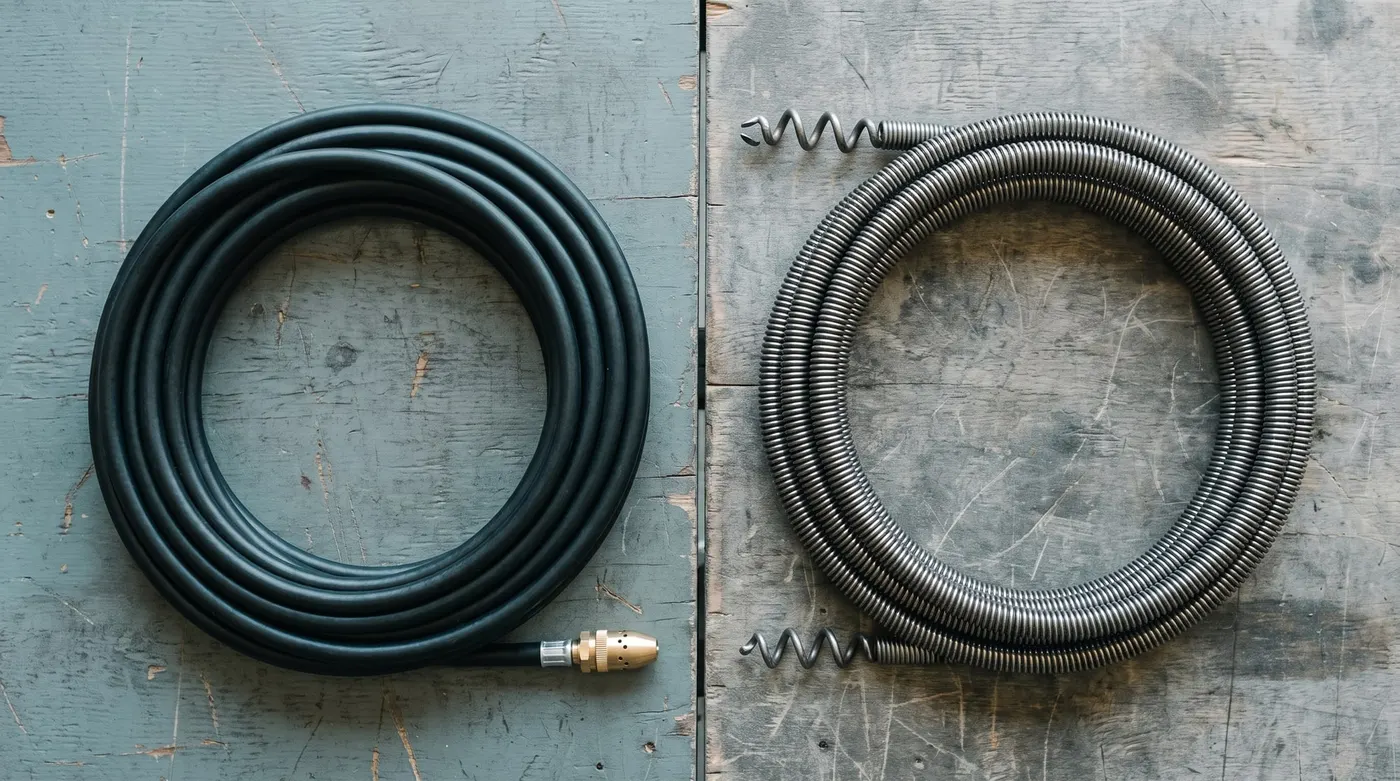
The short answer: a jetter uses water, a snake uses steel, and they solve slightly different problems. A jetter cuts through a blockage and scours build-up off the pipe wall on the way through. A cable machine bores through the blockage and can grip, cut or pull what is in the way. Neither is universally better, and anyone who tells you otherwise is describing the machine they own.
How each one works
The cable machine
A drain snake — also called an electric eel or cable machine — is a long flexible steel cable, usually rotated by a motor, fed into the drain from an access point. A head is fitted to the end: a cutter for roots, a corkscrew or auger for gripping and retrieving, a blade for cutting through obstructions.
The cable is worked into the line until it meets resistance, then rotated to bore through, break up or grip whatever is there. Because it is mechanical, it can apply real force to a specific object. That is its distinguishing capability: it can grab something and pull it back, or cut something that will not move.
The jetter
A high-pressure jetter feeds a hose into the drain with a nozzle on the end. Most of the jets face backwards. That does two things simultaneously: the reaction drives the nozzle forward along the pipe, and the backward-facing water sweeps loosened material toward the access point. A smaller forward jet does the cutting.
The distinguishing capability here is coverage. Water reaches the entire circumference of the pipe wall rather than only the path the tool travels along. That is why jetting can leave a pipe genuinely cleaner rather than merely open.
The difference that matters most
Consider a drain that has slowly narrowed with grease over several years until something ordinary finally stops it.
A cable machine will bore through that grease and restore flow. Water runs again, the job looks finished, and it is — for now. But the pipe still has most of its grease layer, and the channel bored through it is the narrowest part of the whole system.
A jetter attacks the same blockage but keeps working the line afterwards, shearing deposit off the wall. The pipe ends up closer to its original diameter.
That is the core distinction: opening a path versus cleaning the pipe. For a one-off obstruction in a clean line it makes little difference. For build-up that took years to accumulate, it is the difference between a fix and a postponement.
Where each is typically suited
| Situation | Jetter | Cable machine |
|---|---|---|
| Grease and fat build-up | Usually well suited | Opens a path but leaves the deposit |
| Silt, sand and sludge | Usually well suited | Less effective on loose fine material |
| Fine root hair | Can cut and flush it | Cutting heads are designed for it |
| Heavy root mass | Depends on volume and access | Often the practical choice |
| A solid object lodged in the line | Water cannot grip it | Can grip and retrieve |
| Long runs from a single access point | Travels well | Limited by cable length and bends |
| Cleaning the pipe wall, not just the blockage | Its main advantage | Not what it does |
| A pipe in poor condition | Assess first | Assess first |
None of these are absolutes. Access, pipe diameter, pipe material and what is actually in the line all shift the answer, which is why the choice is made on site rather than from a website.
Where both stop being the answer
Both are clearing methods. Neither repairs anything.
If the pipe has cracked, dropped at a joint, collapsed, or sagged into a low spot that holds water, clearing restores flow through a pipe that is still broken. The blockage returns — usually in the same place, usually sooner each time, because the defect that caused it has not changed.
Neither tool tells you which of those you have. You get a drain that runs again, plus whatever came back out of it. That is real evidence, but it is not the same as seeing the inside of the pipe.
Why pipe condition changes the decision
There is a reasonable question about whether high-pressure water can damage a pipe. On a sound pipe, jetting is a normal clearing and maintenance method. The risk sits with pipes that are already compromised.
The problem is that you often do not know which one you have until afterwards. On a drain with no history of trouble, that uncertainty is low and proceeding is sensible. On a drain that has blocked repeatedly, cleared hard, or is known to be old or fragile, the uncertainty is the point — and that is the argument for looking before choosing a method rather than choosing a method and finding out.
This is also why recurring blockages and diagnosis belong in the same conversation. If a drain has blocked three times in two years, the interesting question is no longer which tool to clear it with. It is why it keeps happening, which is what a CCTV drain inspection answers.
Questions worth asking
- Why this method for this blockage? A specific answer is a good sign.
- What condition is the pipe in, and how do you know?
- If this comes back in three months, what would we do differently?
- Is the line being cleaned, or just opened?
None of these are confrontational. They are the questions a reasonable person asks about work they are paying for, and a straight answer to each is easy for anyone doing the job properly.
What to do next
If the drain has blocked once and cleared easily, either method is likely to be the whole answer, and the choice is a practical one about access and what is in the pipe.
If it keeps blocking, the tool is not the question. High pressure drain jetting covers what jetting does and does not solve, and where an inspection belongs in the sequence.